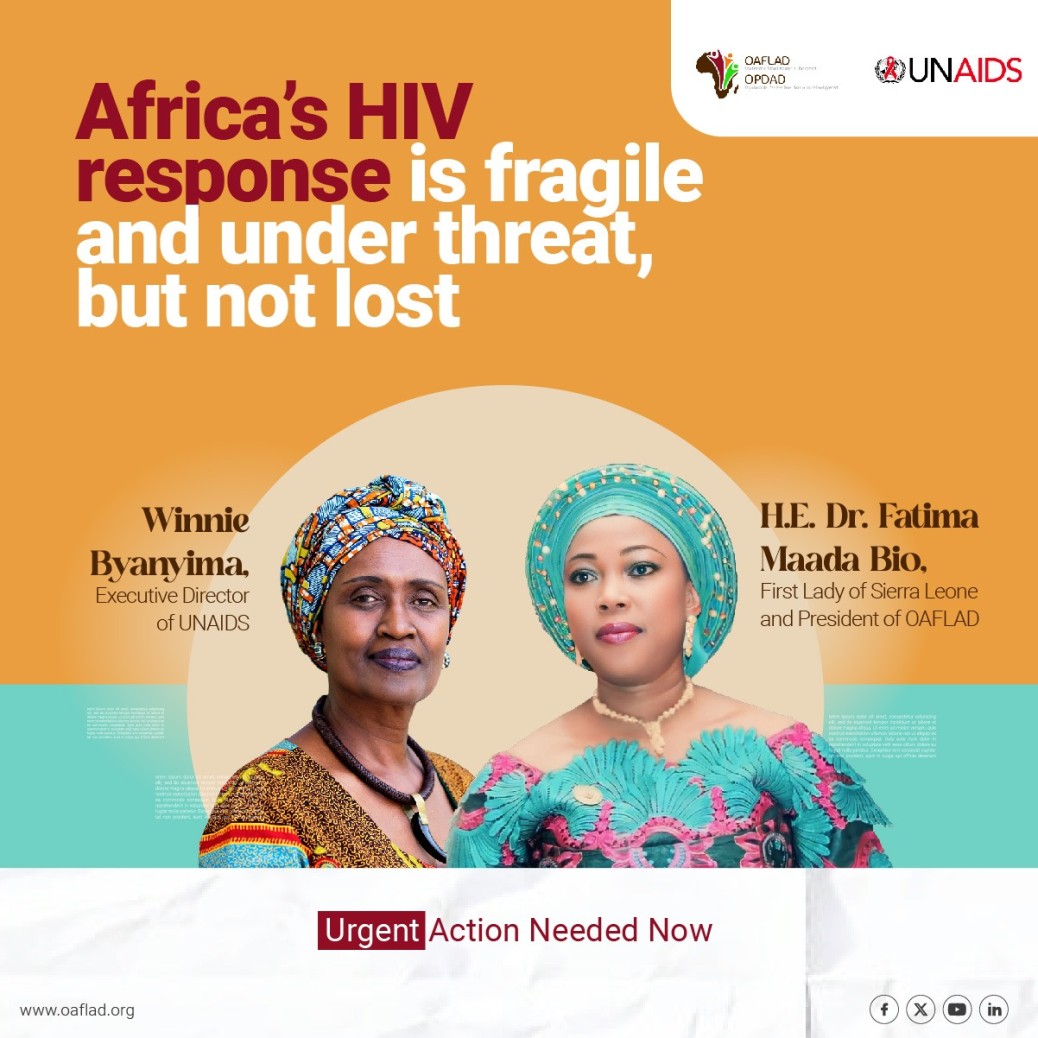
By Her Excellency, Dr. Fatima Maada Bio, First Lady of the Republic of Sierra Leone and President of OAFLAD, and Winnie Byanyima, Executive Director of UNAIDS
24-year old Noncedo Khumalo worked as a peer mentor. She supported women and girls in her community at risk of HIV, especially from older men who target them for transactional sex. But earlier this year, Noncedo’s job ended abruptly, putting the
women and girls she supports at risk.
Her employer, Young Heroes – a local community organization offering HIV prevention and treatment services – was part of the DREAMS initiative, standing for Determined,
Resilient, Empowered, AIDS-Free, Mentored, and Safe. Once supported by the US President’s Emergency Plan for AIDS Relief (PEPFAR), DREAMS has now been cancelled, severing a lifeline for more than 2 million women and girls across 15 countries with high HIV burdens.
Noncedo is worried about the future. Many of the young people she worked with are not well informed about HIV. Condom use is low. Myths, such as the belief that HIV is a “curse” only affecting certain families, are a major driver of new infections. The loss of a
peer mentor – a person like them, whom they can trust – puts these women and girls at risk of HIV infection. She is one of thousands to lose her job amid sudden cuts to international HIV financing – a significant risk in a continent where more than 3,300 adolescent girls and young
women acquire HIV every week.The scale of the setback is alarming. With external funding for health projected to fall by
up to 40% in 2025 compared with 2023 (OECD). Community programmes supporting the people most at risk of HIV have collapsed in several countries. More than 60% of women-led HIV response organizations have lost funding or suspended operations,
leaving entire communities without essential support.And while the consequences will be felt across populations, it is stigmatized communities that will bear the brunt. Adolescent girls and young women are among those at a heightened risk due to fewer economic and educational opportunities, and reduced access to HIV prevention tools.
As the Global Council on Inequalities, AIDS, and Pandemics highlights, inequality is not just a consequence of pandemics, but a powerful driver of them. HIV is more than a health issue – it is a reflection of deeper structural injustices. For example, two-thirds of African countries spend more on debt than on health. Despite these challenges, there are encouraging signs. Many countries have moved swiftly to close funding gaps. The delivery of HIV treatment has remained stable in many countries. Monthly data reported to UNAIDS shows that new initiations of treatment remained consistent during the first half of 2025, even as funding declined. African leaders have pledged to secure diversified and sustainable financing for HIV and other health programmes. Regional initiatives like the Accra Reset and the African
Union Roadmap to 2030 aim to put countries on the path to health sovereignty. And, even in a difficult financial context, donors are not walking away. Communities across the continent are mobilizing support for one another. A new Global AIDS Strategy for 2026–2031 is under development, providing a clear path toward ending AIDS by 2030. New HIV technologies, including long-acting antiretroviral
meidicnes for prevention and treatment, could revolutionize HIV programming – but only with equitable and timely access. For that, we need to expand African-led pharmaceutical manufacturing. African First Ladies have played a transformative and sustained role in the fight against HIV/AIDS across the continent. Through their collective platform, first established as the Organization of African First Ladies Against HIV and AIDS and now known as the Organization of African First Ladies for Development (OAFLAD), they have driven key advocacy initiatives, mobilized resources, and amplified the voices of women, children, and other vulnerable populations most affected by HIV/AIDS. Together with UNAIDS and other key partners, African First Ladies have helped accelerate progress toward eliminating vertical transmission of HIV, expanding access to life-saving medication, and ensuring that HIV remains a political and public health priority. Their work has been instrumental in breaking stigma, promoting prevention and treatment services, and strengthening community-level support systems. And it will be critical for overcoming disruption and transforming the HIV response. Africa’s HIV response is fragile and under threat – but it is not lost. At the 23rd International Conference on AIDS and STIs in Africa (ICASA) in Accra, governments urgently need to protect the gains of the global HIV response. As the world order shifts there is new space for an African Health Agenda. It’s the leadership of national governments that will determine how well we will be able to sustain the progress we have made so far. If leaders move fast, invest in public health, and reduce inequalities, we can secure an AIDS-free future – for women, girls and children, for our communities, and for us all.
DREAMS
https://www.state.gov/wp-content/uploads/2024/12/DREAMS-Fact-Sheet_WAD-2024_FINAL.pdf
__
HIGHLIGHTS
Breaking the inequality-pandemic cycle – Building true health security in a global age